These essays are slow reflections for real life—written from the conviction that faith is not about having all the answers, but about learning to trust God in the middle of ordinary days, honest doubts, and unfinished stories. You’ll find Scripture, personal experience, and gentle theological reflection woven together in a voice that’s more neighborly than preachy.
If you’re curious, weary, hopeful, or somewhere in between, pull up a chair. There’s no pressure to arrive—just an invitation to think, pray, and keep going.
Have you ever noticed that some things are not the way that you would expect them to be?
When it comes to God, it seems that things are almost always upside down and backwards. We expect God to zig and he zags. We expect a warrior and he comes as an infant.
As we prepare, again, for the coming of Christ in Christmas we would do ourselves well to take a moment and consider who he is.
We are to be like him.
He is our big brother.
He is our mentor.
He is our King.
What does this great bringer of peace look like? Not at all what we expect him to be.
In your relationships with one another, have the same mindset as Christ Jesus:
Who, being in very nature God, did not consider equality with God something to be used to his own advantage; rather, he made himself nothing by taking the very nature of a servant, being made in human likeness.
And being found in appearance as a man, he humbled himself by becoming obedient to death — even death on a cross!
Therefore God exalted him to the highest place and gave him the name that is above every name, that at the name of Jesus every knee should bow, in heaven and on earth and under the earth, and every tongue acknowledge that Jesus Christ is Lord, to the glory of God the Father.
This is the mindset and attitude of the great bringer of peace. What is yours?
Does anyone like being disciplined? I don’t. Yet, that’s part of what is happening as the people of God wait during Advent. I explore this idea a little in the part 2 of my ongoing conversation on Advent from the Old Testament.
This Advent season I challenged the congregation I serve to try to engage their imaginations and be surprised by Christmas. Advent is a season of waiting and preparation for the coming of the King. The people of God waited for the Messiah to arrive for 576 years. We know he has come and so we look back on that time of waiting.
But, what if we didn’t have to engage our imaginations? What if, we are in another time of waiting and preparation? What if, we have been waiting even longer for Advent to come to an end than our ancestors?
We have.
We who are on the other side of the resurrection know that Christ has come, that he has lived, that he has died, and that he has risen. We know that he sits at the right of the Father.
Yet, we still wait.
We wait for his second coming, the ultimate coming of the Christ when he finally makes all things right and makes all things new. When he wipes away every tear, when faith becomes sight.
The first century followers of Jesus were waiting with baited breath for his return. So much so, that some of the early leaders in the Church had to remind them to go to work and care for their families, because God does not work on our schedule.
Still, here we are two thousand years later and we wait.
Two thousand years later and the Christ has not returned. We continue on seeking to be the body of Christ wherever we are.
Two thousand years later we are still working out what it means to love our neighbor as ourselves.
Two thousand years later we are in Advent.
The difference between then and now is that there was a resurrection. The difference between then and now is that the Holy Spirit lives in us.
But, just like then, we wait.
Check out what Jude (yes, I know you’re humming Hey Jude! now, get out of your system, you good? OK,):
But you, dear friends, by building yourselves up in your most holy faith and praying in the Holy Spirit, keep yourselves in God’s love as you wait for the mercy of our Lord Jesus Christ to bring you to eternal life. — Jude 20–21
We build one another in our faith. We pray in the Holy Spirit. We keep ourselves in God’s love.
AND WE WAIT.
How are you waiting? Who are you building up? Are you praying? How are you loving well?
To wait with patient expectancy is an active waiting. It is not passive.
I think as we seek to live this way we experience something deep within ourselves. We will experience joy.
My hunch is this, if you are not a joyful person then you are not building others up, you are not praying, and you are not seeking to love well. If we engage in these activities then we can’t help but be joyful.
Approximately eighteen months ago I was plunged into a dark night of the soul. I stepped off a cliff and began to experience something that is commonly called, “deconstruction.” All of the answers about God, faith, and Jesus fell apart. They all seemed thin. None of them appeared to be grounded in anything substantial.
I was wrestling with faith and doubt in ways that I had never known. It was hard and frustrating and utterly painful. I desperately wanted to escape from this period of my life.
I wanted all the answers to make sense again.
My greatest desire was to hear God’s voice and feel God’s presence like I had when I was younger.
But, his voice stayed silent. His presence seemed absent.
So, I searched.
I waited.
I cried out.
I waited more.
I searched again.
I cried out again and again.
Then, God did something. He made himself known to me in his people. He showed me himself through the people who call themselves his. From that moment on I’ve had a new song, a new faith, a clearer sense of the reality and beauty and mystery of God.
I rediscovered joy.
David wrote a poem that resonates with me like it never has before. Here’s the first stanza:
I waited patiently for the Lord; he turned to me and heard my cry. He lifted me out of the slimy pit, out of the mud and mire; he set my feet on a rock and gave me a firm place to stand. He put a new song in my mouth, a hymn of praise to our God. Many will see and fear the Lord and put their trust in him. — Psalm 40:1–3
One of my favorite bands, U2, recorded a version of this psalm and it has become an anthem for me. I leave you with it:
Last night my wife and I had a conversation with our son about how I, “make people mad.” It was kind of a fun conversation because my wife kept saying, “Your dad is not a jerk about things, well, he used to be, but he’s not any more. Now, he simply knows what is right and true and he doesn’t back down.”
Those were really encouraging words for me because as I shared yesterday, I have had to be “humbled” quite a bit. But, now when I “make people mad” it’s often because they simply don’t like what they are hearing.
It turns out that when you have integrity and character those are really subversive traits in today’s society.
Some Scripture
This morning I was reading about John the Baptist in Matthew 3. He was a guy that had integrity, character, and spoke the truth. He knew who he was and who he wasn’t. He embraced his identity. I love what he says here in verse 11,
I baptize you with water for repentance. But after me comes one who is more powerful than I, whose sandals I am not worthy to carry. He will baptize you with the Holy Spirit and fire.
How different is his attitude than ours? Can you imagine a pastoral transition where the outgoing pastor says of the incoming one, “Folks, this guy is such a great man that I’m not even worthy to carry his shoes.”
What usually happens?
Usually, the outgoing pastor has either been fired or if he’s retiring and trying to pass off the baton he sticks around and makes life miserable for the new guy.
These are the moments that show us what a person’s character and integrity are. Can we come to terms with the reality of who we are not? This was one of the key things about John being a man of integrity, he knew who he wasn’t. He wasn’t the Christ and let everyone know.
Do you know what happened to John the Baptist?
He lost his head.
Quite literally.
The powers that be didn’t like him and had his head removed from his neck.
It turns out that being a person of integrity and character was pretty subversive in the first century too.
So What?
What does any of this have to do with Advent and joy? That’s a great question. I think that one of the ways that we experience joy is in the context of living out of our identity. Being who we are in every sphere of influence we find ourselves in.
What I mean is this: We are to be the same person at home, at work, at play, with family, with friends, and with strangers. We are to live a life that is integrated and is based in who we are and the acceptance of who we are not.
When we live this way we will begin to experience joy. Not necessarily happiness. When you live with integrity and character it is not always going to be easy (thankfully you probably won’t lose your head), and so you might not necessarily be happy. However, joy is deeper and more enduring than happiness.
Joy is a sense of contentment knowing who you are and how you are to live.
Seriously. Who says stuff like this? When you’re in the midst of being “humbled,” do you think, “Boy howdy! This is great!”
I sure don’t.
When I was in college, I was in a Bible study with a couple of other guys. We were leaders in our CRU movement at Central Michigan University. Each week we began with 15–30 minutes known as, “What did Dan do wrong this week.” Our poor small group leader would have a laundry list of stupid things that I had said or done.
It was definitely, humbling.
I definitely didn’t enjoy it.
I most certainly didn’t think it was good.
However, as I look back at these times I realize that they were some of the most significant moments in my life. It was then that I began to learn how to say, “I’m sorry, I was wrong, please forgive me.” During these months I also learned when to have boundaries and stand up for myself when I was in the right.
“What did Dan do wrong this week,” shaped me in ways that I’m still experiencing to this day.
I was reading in Psalm 119 today and ran across this line,
It is good for me that I was humbled, so that I might learn your statutes.
Psalm 119:71
This is one of the truest and most discomforting lines of poetry that I have ever read.
We all know it’s true too. Each of us knows that it takes us being humbled to really learn.
It is indeed good for me that I was humbled, so that I might learn who God is and know his grace.
This week in Advent is the week of joy. It turns out that being humbled has brought me great joy. That joy resides not in comfort but in the fact that I have been transformed and that in the process of being humbled I have known grace.
Originally published at danielmrose.com on December 19, 2018.
There’s a famous Advent reading that I’ve always found to be really weird. It’s Isaiah 9:6 and I read it again today. Check it out in the NIV:
For to us a child is born, to us a son is given, and the government will be on his shoulders. And he will be called Wonderful Counselor, Mighty God, Everlasting Father, Prince of Peace. Of the greatness of his government and peace
It’s beautiful and traditional and points us to the majestic beauty of the coming Messiah. I absolutely love this verse. Yet, it’s super weird too.
First, the “government will be on his shoulders,” has never sat well with me. It’s felt so out of place and really never made sense to me. When I read the passage this morning it was in a translation of the Bible that I had never read it out from before, the NRSV. It translates the phrase this way, “authority rests upon his shoulders.”
I had an “AHA” moment.
My guess is that for many of you this is nothing new. But, for me it was a “WOAH! I get it! WHAT!?” kind of moment.
Authority: the power to determine, adjudicate, or otherwise settle issues or disputes; jurisdiction; the right to control, command, or determine.
When I think of the reality that Jesus has authority, particularly the power to settle issues, it brings so much into laser focus for me. Throughout the prophets in the Old Testament we see the people of God being put on trial by God, in a sense. We also see the people of God putting God on trial too. They are found guilty of setting God aside and end up being exiled.
Yet, there is this promise of the Messiah to come. The one who would bring them home. This weird little verse gives us a glimpse into the foundation for the Messiah to be able to do that. It is because he has authority. He has the power to settle issues.
Second, the other weird thing about this verse is the “wonderful counselor” bit. I always had in my head a picture of God with a notebook doing counseling. Today though, with my “AHA” moment on the “government” issue, I realized that I should look more deeply into the “wonderful counselor” bit too.
The word “counselor” could be understood as “strategist.” The NET Bible translates the phrase, “extraordinary strategist.”
Again, “AHA!”
The kind of counselor we are talking about is the kind of person that was wise and strategic. These are two of the things that I see in Jesus ministry and here they are, on display, in this prophecy.
I mean, come on.
You know, I have been studying the Bible a long time and have told people for years to check different translations, etc… Isn’t it funny how going back to the basics can be such a big deal?
Originally published at danielmrose.com on December 18, 2018.
In theological circles there are some technical words that get applied to certain perspectives of theology. I am what is known as a “monergist.” Simply put, this means that I believe God does all the work in bringing about salvation. It is purely by his grace and mercy and there is nothing that we can do to add to our salvation or to bring it about.
Sometimes we also need to talk about what something doesn’t mean. Being a “monergist” doesn’t meant that I hold to some sort of cold, impersonal determinism. It also doesn’t mean that I don’t think we have any responsibility regarding our spiritual lives.
Two things are becoming more clear to me in these days. First, the way salvation works is a mystery. I don’t think I’m ever going to be able to unravel the definite machinations of the how.
This mystery is beautiful and glorious and intriguing and messy.
Second, we have a responsibility to support our faith. Peter writes,
For this very reason, you must make every effort to support your faith with goodness, and goodness with knowledge, and knowledge with self-control, and self-control with endurance, and endurance with godliness, and godliness with mutual affection, and mutual affection with love.
2 Peter 1:5–7
This passage starts with a “For this very reason…” The very reason that Peter is pointing to is in verse 4 where he says that we “…become participants of the divine nature.”
The contemporary idea that faith is nothing more than eternity insurance has no place in Christianity.
When we say we are trusting Christ, or following Christ, or that we are “saved,” it means that we are participating with Christ in the divine nature. This is called “union with Christ.”
If we are participating in the divine nature then our lives will begin to look different. I love how Peter says that we must “make every effort to support your faith.” There is a distinction that he makes there. Our faith is not something that we work up, it’s a gift, it’s given to us by God. But then we have a responsibility to do something with it.
Have you known of athletes who are members of the “Coulda Been Great” Society? I sure do. These are athletes that had tons of raw, God-given ability, and yet they did nothing with it. They were given a gift and didn’t develop it.
The same is true of our faith. We are called to act upon our faith. It is to practically change us. Our lives should be different because of our faith.
Goodness.
Knowledge.
Self-control.
Endurance.
Godliness.
Mutual affection.
Love.
Do you see the progression here? Take a moment and ask yourself how you’re doing. It’s OK to take a little stock every now and then. Are you supporting your faith by practicing goodness? Pursuing knowledge? Practicing self-control? Enduring? Seeking to be godly? Practicing mutual affection? And, loving?
In many ways you could summarize this with, “Don’t be a jerk.” Or, “Love your neighbor.” Or, “Be a good person.”
This week is the third week of Advent with its focus on joy. The joy of this week is the sure and certain knowledge that our king is coming. The thing is, when our king comes our lives will need to look different. True joy, the joy that goes beyond being happy, is based and rooted in our identity. We experience joy when we are living out who we are.
If your life was marked by goodness, knowledge, self-control, endurance, godliness, mutual affection, and love how much joy would know? How much joy would experience?
My friends, support your faith with your life. Live a life that honors our King and you will know JOY.
Originally published at danielmrose.com on December 17, 2018.
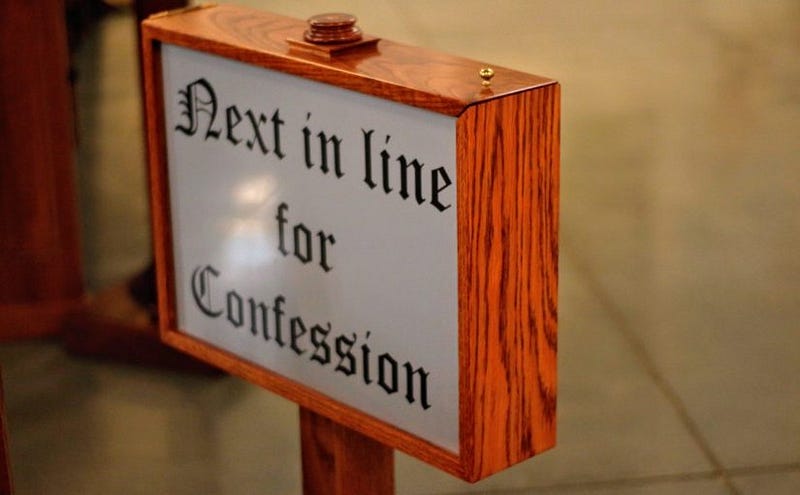
When you hear the word “confession,” how do you feel? It makes me a bit uncomfortable. I am not all that excited about airing all my dirty laundry.
When you hear the word “sin,” how do you feel? If you’re like most of us these days you probably think, “Who are you to judge? Jerk.”
Something that I keep trying to lean into in my life is reality. I want to honestly assess myself. That whole “know thyself” thing has become a near obsession. There is great power in understanding ourselves, our passions, our calling, our longings, and our brokenness.
Too often I find that I try to talk myself out of my brokenness. When I mess up in relationships with others or myself, I typically try to argue it away. When I’m unloving or uncaring, I usually project my brokenness onto others.
Owning our own stuff is really hard to do. It demands us to practice the ancient spiritual discipline of confession.
I’m a protestant and this act of confession is made a bit harder for me because there is no standard practice of it in my tradition. My Catholic friends who are serious about their faith go and make confession regularly to their priest. There is an understanding that they need this and they need someone to hear their confession.
For us protestants we have held to the idea that confession is something just between us and God. Which it is, but not “just.” Why? Because we need someone who will say, “Is there anything else? Did you lie to me?”
Confession is good for the soul. It is good for our well-being. Owning our sin and getting rid of it is like oxygen for our spirit. I love the image of spiritual breathing. The picture that you exhale your sin (like carbon dioxide) and inhale grace (like oxygen).
The ancient Jewish king, David, wrote a poem where he says,
Happy are those whose transgression is forgiven, whose sin is covered. Happy are those to whom the LORD imputes no iniquity, and whose spirit is no deceit.
While I kept silence, my body wasted away through my groaning all day long. For day and night your hand was heavy upon me; my strength was dried up as by the heat of summer.
Psalm 32:1–4
Two things stand out to me in this poem. First there is happiness when we know we are forgiven. There is happiness in the experiential knowledge of grace. Second, holding onto sin in silence kills us from the inside out.
In another poem this same king writes,
Sing praises to the LORD, O you his faithful ones, and give thanks to his holy name.
For his anger is but for a moment; his favor is for a lifetime. Weeping may linger for the night, but joy comes with the morning.
Psalm 30:4–5
When I confess my sin to another, when I confess my sin to God, my greatest fear is anger. I worry that they will break the relationship. With those who are faithful friends, like God, their anger is momentary. Usually it is not even anger so much as disappointment. But their favor lasts a lifetime.
When I invite friends into my confession they become for me agents of grace. They speak words of grace to me.
When grace comes then comes joy.
Tomorrow morning we will light the third candle of Advent, the joy candle. Truly joy comes in the morning.
Originally published at danielmrose.com on December 15, 2018.
It is often said that the night is darkest before the dawn.
It is also said that,
“You see, at just the right time, when we were still powerless, Christ died for the ungodly.”
Romans 5:8
As I write this, there is no sun outside my window. I am seated at my desk looking out over my neighborhood and the sky is gray, flat, and weary.
There is little life.
The leaves are gone.
The rose bushes are in hibernation.
The only light is the small desk lamp that is focused on my copy of the Scriptures.
The night is darkest before the dawn.
Could you imagine how dark it must have felt those days before the coming of the Christ? It had been 576 years since the promise of Jeremiah that the Christ would come. It had been 400 years since the last prophet, Malachi, had preached. The darkness must have felt unending.
One of my favorite books to read is The Lion, The Witch, and The Wardrobe by C.S. Lewis. It’s the tale of a magical land, Narnia, that is trapped in an everlasting winter with no Christmas. Surely, this is what it must have felt like for the people of God from Malachi to Christ.
In one of David’s psalms, Psalm 31, he writes,
I will exult and rejoice in your steadfast love, because you have seen my affliction; you have taken heed of my adversities.
Psalm 31:7
David, experienced and felt the love of God because he encountered God in his pain. Think about that for a moment.
It was not because he was without pain that he knew God loved him.
It was because in his pain he encountered God. This is completely opposite of how we often think of and understand our relationship with God.
Too often, when the night is darkest we doubt that God loves us. Yet, it is in the darkest night that God meets us in our pain because he is the one who will never leave us or forsake us.
We are in the midst of the darkness of Advent. There is great struggle as we wait. As we do, let us pray and reflect on these words from Psalm 31,
Love the LORD, all you his saints. The LORD preserves the faith, but abundantly repays the one who acts haughtily.
Be strong, and let your heart take courage, all you who wait for the LORD.
Psalm 31:23–24
Originally published at danielmrose.com on December 14, 2018.
This past summer I was watching a Detroit Tigers game and they were interviewing Nicholas Castellanos, one of the Tigers better hitters. He had just come off a very long slump and the interviewer asked, “How do you handle the ups and downs of baseball?”
Castellanos didn’t miss a beat. He talked about his dad. He said that while he was growing up his dad would tell him all the time that he was the best. So, whenever he is going through a down time in the season he just remembers his dad’s voice.
That interview has stuck with me a long time. I wonder if we believe that our heavenly Father loves us the way Castellanos’ dad loves him?
Life is really hard. The good times and the bad times both come and go. Seemingly with no rhyme or reason.
When the bad times come, how do we respond? Will we be able to hear our Father’s voice, the one that says, “I love you, you’re the best.”
King Ahaz, an ancient Jewish King, was having a real bad time. He inherited a kingdom that was in disarray. The people of God had rebelled against God. The nation was about to be exiled. In Isaiah 7 we read that his heart “shook as the trees of the forest shake before the wind,” because the nations of Aram and Israel were coming to attack Jerusalem.
Isaiah went to encourage Ahaz in his faith. He told him not to fear, to be quiet, and not to let his heart faint. He even talks a little smack about the two nations coming to destroy Jerusalem. There is a sense that God is saying, “I see you. I got you.”
Then at the end of the conversation Isaiah says,
If you do not stand firm in faith, you shall not stand at all.
How could he though? Two armies were knocking at his door. I would have been afraid too. Yet, Isaiah calls him to stand in faith.
I think in the midst of this is the reminder that God loves us. He loves us and will meet us in our bad times. When those times come we need to hear the voice of the Father saying, “I love you, you’re the best.”
When we know we’re loved we can stand firm in the faith.
During this time of Advent, while we are waiting, we must stand firm in the faith. What will ultimately give us our strength to stand is the knowledge that we are loved.
Do you believe this? Do you believe that you are loved?
Originally published at danielmrose.com on December 13, 2018.
“He sees you when you’re sleeping, he knows when you’re awake. He knows if you’ve been bad or good; so be good for goodness sake. Oh…You better watch out, you better not cry, you better not shout, I’m telling you why…”
So the old song goes.
Thankfully, God is nothing like Santa Claus.
I have been reading a lot of psalms this Advent season and one of the things that constantly strikes me is that there is no limit on the crying and shouting. Every human emotion is present in the lines of the poems that make up the book of psalms.
There is no holding back.
There are no holds barred.
There is just pure unadulterated emotion and passion. The psalmists pour out everything that is within them to their God. It is uncomfortable to read some their words.
There are times when I think, “Wow. I can’t believe they wrote that and left it for posterity.”
At other times I think, “I wish my relationship with God were so honest and real.”
In Psalm 38 David writes,
I am utterly spent and crushed; I groan because of the tumult of my heart. O Lord, all my longing is known to you; my sighing is not hidden from you. My heart throbs, my strength fails me; as for the light of my eyes — it has also gone from me.
He is in misery. Yet, he turns his heart to God in brutal honesty.
Later in the psalm he writes,
But it is for you, O LORD, that I wait; it is you, O Lord my God, who will answer.
I am coming to learn that it is this unyielding belief that God sees and knows and will answer that drives David to brutal honesty with God. Because he is confident that God sees, he knows that he can cry out with our reservation.
Unlike Santa, God does not want us quiet and good. God wants us authentic and real. He wants us passionate and honest. God wants us to know him and be in relationship with him.
The God who sees is ready for us to cry and ready for us to shout because he knows all too well our pain and our struggles.
How does he know that?
Because after Advent comes Christmas.
Originally published at danielmrose.com on December 12, 2018.
How long must we wait? How long will the exile to darkness last? How long until the master comes to his temple to make all things right? How long until faith becomes sight?
WE WAIT.
The longer Advent goes and the longer I try to imagine what it must have been like to live in exile and to long for the coming Messiah, I grow in my sense of anticipation and frustration. I want Christmas to come and I want it to come now. I want the light and voice and presence of God.
Yet the darkness grows and we wait.
I find myself now looking for glimpses of the divine around every corner. I try to see God in the little moments of laughter and joy. God, during this season of Advent, seems to be just out of reach but inviting me to come along further up and further in.
The psalmist writes,
The LORD is a stronghold for the oppressed, a stronghold in times of trouble.
And those who your name put their trust in you, for you, O LORD, have not forsaken those who seek you.
Psalm 9:9–10
His invitation in the midst of the waiting is to “seek.” It is not a passive, sit on the porch and hope to see God, kind of waiting.
No, he invites us to seek him and we will not be disappointed. If we seek God he will not forsake us. He will not hide forever. We will eventually find him.
We don’t wait, we SEEK!
Originally published at danielmrose.com on December 11, 2018.