Posts in "Quotes and Notes"

Dietrich Bonhoeffer composed a number of talking points to refute what was known as the “Aryan Paragraph” in September of 1933. The paragraph excluded non-Aryans from civil service which was beginning to be adopted by German churches.

Currently reading: The Bonhoeffer Reader by Michael P. DeJonge 📚

The German Christians say: The church is not allowed to undo or to disregard God’s orders, and race is one of them, so the church must be racially constituted. We answer: The given order of race is misjudged just as little as that of gender, status in society, etc. . . . In the church, a Jew is still a Jew, a Gentile a Gentile, a man a man, a capitalist a capitalist, etc., etc. But God calls and gathers them all together into one people, the people of God, the church, and they all belong to it in the same way, one with another. The church is not a community of people who are all the same but precisely one of people foreign to one another who are called by God’s Word. The people of God is an order over and above all other orders. “Who is my mother, and who are my brothers? . . . whoever does the will of my Father in heaven is my brother and sister and mother” [Matt. 12:48, 50]. Race and blood are one order among those who enter into the church, but it must never become a criterion for belonging to the church; the only criterion is the Word of God and faith.
&10;
&10;DeJonge, Michael P.; Green, Clifford J.. The Bonhoeffer Reader (Function). Kindle Edition.

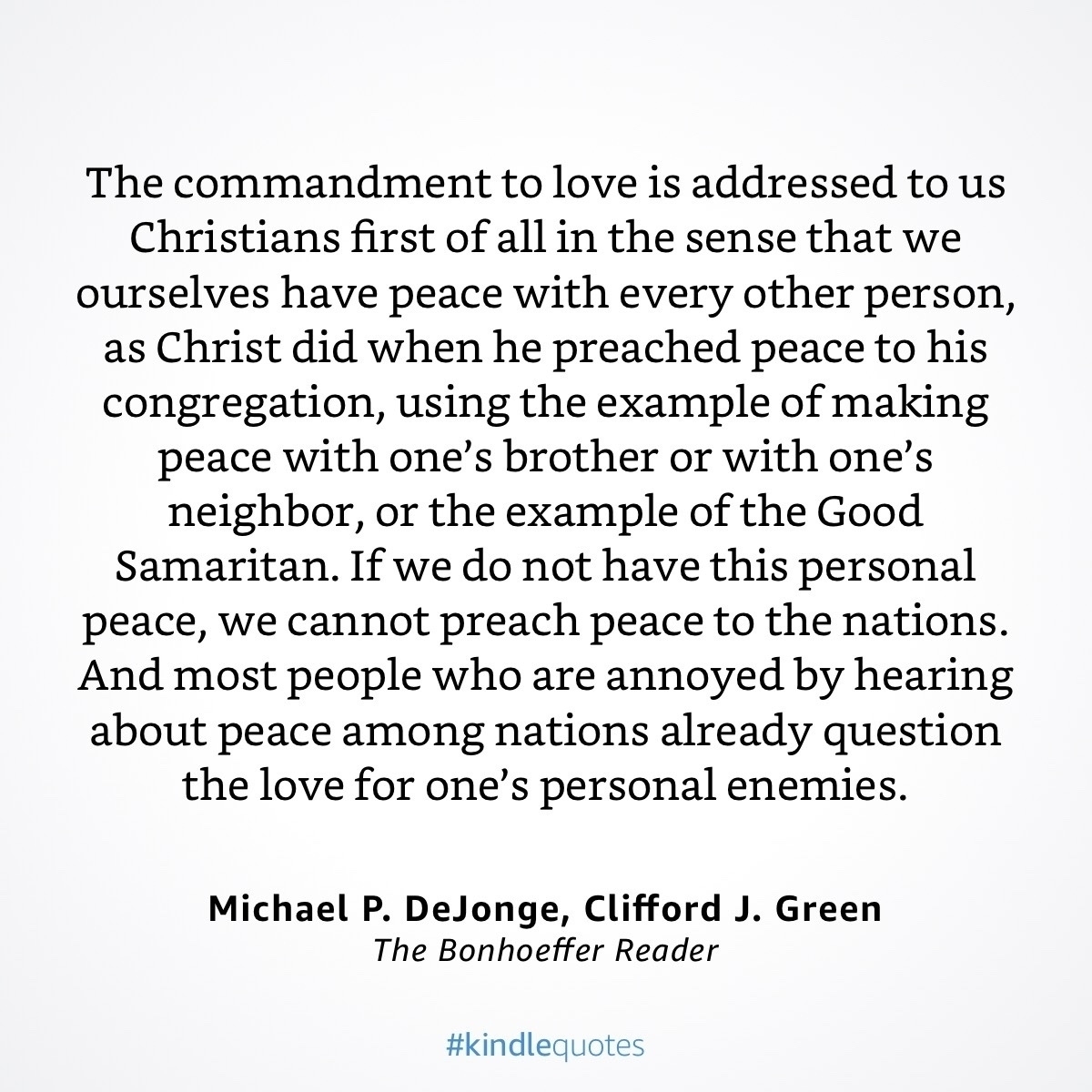
From Bonhoeffer on the command to love our neighbor and enemy. This was from a talk he gave to a student organization at the end of 1932.

I am really bad at this. I need to grow.

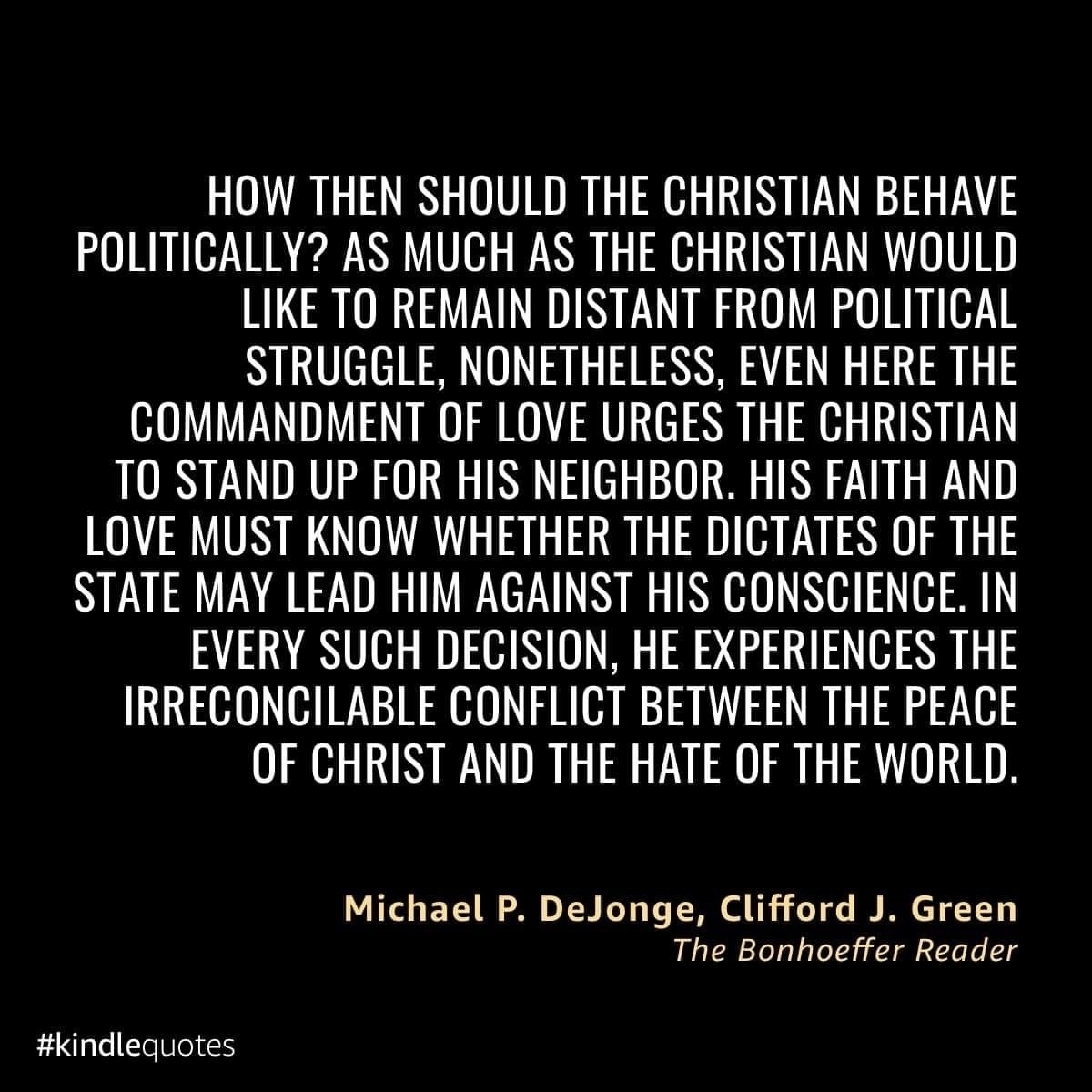
I am still processing this quote from my reading last night. This is part of Bonhoeffer’s conclusion on a talk on the prayer, “Thy kingdom come.”

Too often the American Church has derided struggle as a sign of not keeping “in step with the Spirit.”

Yet, as we read the Scripture we see over and over again that struggle is central to inbreaking of the kingdom of God.

This is a quotation from Bonhoeffer’s catechism. It strikes me as very timely.

Finished reading: Following Jesus by N. T. Wright 📚

I’m excited to share some quotes and notes from this little book. It is an excellent read!

"Yes, there was a whiff of triumph on Palm Sunday, but not the kind of triumph that might impress Rome and not the kind that impressed crowds in Jerusalem for long either. What manner of king was this?"

From: The Jesus I Never Knew by Philip Yancey 📚

This week, let us consider the different manner of king that Jesus was.

Jesus himself had mixed feelings during the clamorous parade. Luke reports that as he approached the city he began to weep. He knew how easily a mob could turn. Voices who shout “Hosanna!” one week can shriek “Crucify him!” the next.

From: The Jesus I Never Knew by Philip Yancey 📚

As we step into holy week this quote has been on my mind. Particularly, “how easily a mob could turn.”

Would I have turned?

Would I have shouted “Hosanna!” and then shrieked, “Crucify!”?

I know of no more poignant contrast between two human destinies than that of Peter and Judas. Both assumed leadership within the group of Jesus’ disciples. Both saw and heard wondrous things. Both went through the same dithery cycle of hope, fear, and disillusionment. As the stakes increased, both denied their Master.

From: The Jesus I Never Knew by Philip Yancey 📚

If this isn’t a “but by the grace of God go I,” I don’t know what is.

Jesus’ response to suffering people and to “nobodies” provides a glimpse into the heart of God. God is not the unmoved Absolute, but rather the Loving One who draws near.
from: [The Jesus I Never Knew](https://micro.blog/books/9780310295815) by Philip Yancey 📚

This might be one of the most challenging concepts for many American Christians to wrap our minds around. We have been told for so long that God is non-emotional. Yet, in the person of Jesus, we see God draw near in love. This is the consistent response of Jesus in the Gospels to the people who are on the “outside.”

Indeed, the kingdom of God will grow on earth as the church creates an alternative society demonstrating what the world is not, but one day will be: Barth’s prescription of “a new sign which is radically dissimilar to [the world’s] own manner and which contradicts it in a way which is full of promise.”
From: [The Jesus I Never Knew](https://micro.blog/books/9780310295815) by Philip Yancey 📚

I imagine this alternative society would look vastly different from what we see today.

Jesus had but to give a nod of agreement and he could have constructed Christendom, not on four shaky Gospels and a defeated man nailed on a Cross, but on a basis of sound socioeconomic planning and principles. . . . Every utopia could have been brought to pass, every hope have been realized and every dream been made to come true. What a benefactor, then, Jesus would have been. Acclaimed, equally, in the London School of Economics and the Harvard Business School; a statue in Parliament Square, and an even bigger one on Capitol Hill and in the Red Square. . . . Instead, he turned the offer down on the ground that only God should be worshipped.

The Jesus I Never Knew by Philip Yancey 📚

Jesus: “Nah, I don’t want Christendom.”

The American Church: “Hold my grape juice.”