
Listen to the unabridged sermon here: Blind Spots
John 7–9
We’re taking a big swing this week — three chapters at once, John 7, 8, and 9. It’s a lot of ground, but these chapters actually hang together as one connected sermon of their own. John gives us a point, then an illustration. Another point, another illustration. Two claims from Jesus, two stories that show us what those claims mean in real life. And all of it happens against the backdrop of one specific moment: Jesus at the Feast of Tabernacles in Jerusalem.
The Feast Behind the Story
If you don’t know the Feast of Tabernacles, you’ll miss half of what’s happening in these chapters. The festival centered on two dramatic images — water and light.
Each morning of the seven-day feast, the priests processed to the Pool of Siloam, drew water, and carried it back to the temple, where it was poured out at the altar alongside wine. The crowd sang the Hallel — Psalms 113–118 — while shaking instruments called lulavs that produced a sound like rushing wind, echoing Zechariah’s promise of living water and the Spirit poured out in the last days. On the seventh and greatest day, the priests circled the pool seven times. It was the climax of the feast — and it’s almost certainly the moment Jesus stood up and said the words we’re about to read.
The second image was light. Each evening, priests lit four enormous golden lampstands in the Court of Women — lamps so bright, tradition says, that they lit up the entire city of Jerusalem. Dancing, singing, and celebration went late into the night.
Hold those two images — water and light — because you can’t understand John 7, 8, and 9 without them. Jesus is about to claim both.
“I Am the Living Water”
On the last and greatest day of the feast, right after the priests finished their water-pouring ceremony, Jesus stood and said in a loud voice:
“Let anyone who is thirsty come to me and drink. Whoever believes in me, as Scripture has said, rivers of living water will flow from within them.” (John 7:37–38)
He’s not making a passing comment. He’s standing in the middle of the very ceremony that symbolized this need, and saying: that water is about me. I am the fulfillment of what this festival has been pointing to all along.
It’s the same claim he made to the woman at the well back in John 4 — he is the water that actually satisfies thirst. And it’s a direct challenge to what the feast had become. These festivals were meant to be signposts pointing people toward the hope they had in God. Instead, they’d calcified into insider events — dead traditions kept because they had to be kept, not because they still pointed anywhere.
Notice the word in verse 37: anyone. Not just observant Jews. Not just priests, not just people who know the rules and keep the traditions. Anyone who is thirsty. It’s another glimpse of the gospel broadening — grace, mercy, forgiveness, offered to all, not reserved for people of a particular family, ethnicity, or pedigree.
The crowd, predictably, split over him. Some said he was the Prophet. Some said Messiah. The religious leaders dismissed the idea because he came from Galilee, not Bethlehem. Even Nicodemus — one of their own — got shut down for asking a fair question. It’s a preview of what’s coming.
The Illustration: A Woman, a Trap, and What’s Missing From the Story
Chapter 8 opens with the story often called the woman caught in adultery. It’s worth pausing on the textual history here: our oldest and most reliable manuscripts of John don’t include this passage. Some later manuscripts have it; others place the same story inside Luke’s Gospel instead. It’s one of those places where the ancient evidence isn’t tidy. I’m comfortable with that ambiguity — we’re working with texts that are two thousand years old, and the church has long recognized this story as authentic to who Jesus is, even if its manuscript history is uneven. So we take it up here, where it’s traditionally placed.
The religious leaders drag a woman before Jesus, caught in adultery, and cite the law of Moses: she should be stoned. It’s a trap, not a genuine legal question.
Here’s what’s worth noticing: who’s missing from the story. The man. It takes two people to commit adultery, and only one of them is standing in front of Jesus. The religious leaders were selective. That’s what happens when relationship gets replaced by rule-keeping — you start deciding who counts and who doesn’t, who gets grace and who gets excluded. Earlier in John 7, Jesus had already named this: “You judge from the outside. I judge from the inside.” When people who hold power over tradition get to decide who’s in and who’s out, the whole system tilts toward exclusion.
Jesus’s response has echoed for two thousand years: “Let any of you who is without sin be the first to throw a stone.” And one by one, oldest to youngest, they walked away. The older ones recognized the truth about themselves first; it took the younger ones a little longer to notice they were the only ones left holding rocks.
None of us are exempt from that story. But by the grace of God go I — that was something my Mimi used to say when we’d see hard things or feel the pull to judge someone. It’s still true. Given the wrong circumstances, none of us are above what we’re quick to condemn in someone else. And yet we still do it — we still bring “a woman caught in adultery” before the court of our own opinions, quietly deciding who’s really a Christian, who really gets it, who doesn’t count.
Jesus doesn’t leave her condemned, and he doesn’t leave her unchanged: “Neither do I condemn you. Go now and leave your life of sin.” Grace and truth, together, refusing to let either one cancel the other out.
“I Am the Light of the World”
The story continues directly into Jesus’s second great claim: “I am the light of the world. Whoever follows me will never walk in darkness, but will have the light of life” (John 8:12).
Remember those four lampstands blazing over the Court of Women, lighting up all of Jerusalem? Jesus is saying: that was always just a symbol. I am the thing it was pointing to. And once again, the claim is universal — this isn’t light for the sons and daughters of Abraham only. It’s light for the whole world.
The Pharisees push back immediately, questioning his authority to testify about himself. Jesus doesn’t back down: he stands with the Father who sent him, and his judgment is true. It’s another moment where the gap widens between people who are watching for the categories they already know and people who are actually seeing what’s in front of them.
The Illustration: A Man Born Blind, and the Slow Work of Actually Seeing
That gap becomes the whole plot of John 9. The disciples open with the wrong question — “who sinned, this man or his parents, that he was born blind?” Jesus reframes it entirely: neither. This happened so the works of God could be shown in him. Then he heals him, and declares again: “I am the light of the world.”
What follows is one of the most human passages in the Gospel — an interrogation that becomes, almost by accident, a portrait of what faith actually looks like as it grows.
First round: the man is asked what happened. His answer is simple. “The man they call Jesus made mud, put it on my eyes, and told me to go wash. So I went and washed, and now I can see.” At this point, Jesus is just a name he heard.
Second round: pressed again, he goes further. “He is a prophet.” A category, a guess, a step forward.
Third round: the religious leaders dig in, insisting they don’t even know where this Jesus came from. And the man — with no theological training, just his own restored eyes — makes the sharpest observation in the whole exchange: “Nobody has ever heard of opening the eyes of a man born blind. If this man were not from God, he could do nothing.” He’s moved from a name, to a guess, to a theological conviction. For this, they throw him out of the synagogue.
Jesus finds him afterward — the same pattern as always, going after the one who’s been excluded — and asks him directly: “Do you believe in the Son of Man?” The man asks who he is, so he can believe. Jesus tells him: “You have now seen him. In fact, he is the one speaking with you.” And the man — who was blind — says, “Lord, I believe,” and worships him.
That’s the whole arc of the chapter in miniature: a name, to a prophet, to a man from God, to Lord. Sight that started as physical becomes spiritual. Meanwhile, the men who could see perfectly well with their eyes never see him at all — because they were looking through the grid of their rules and rituals the entire time.
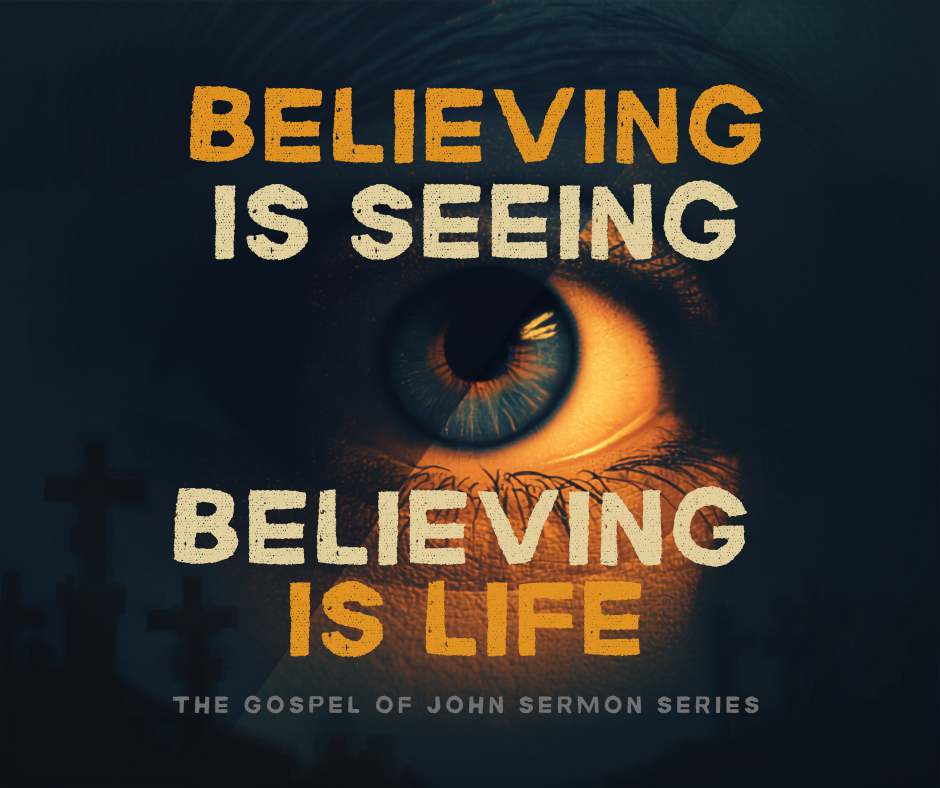
Seeing is not believing. Believing is seeing. And believing is life.
What’s the Equivalent for Us?
Both stories — the woman caught in adultery and the man born blind — are about people receiving life from the one who is the living water and the light of the world. Both stories are also about religious people who had every advantage and still couldn’t see him, because a rule or a ritual or a tradition mattered more to them than the actual person standing in front of them.
So here’s the question I keep landing on: where do we do the same thing?
Where have we decided that someone doesn’t count because they don’t act, dress, think, or vote the way we think they should? Where have our rules and traditions become more important to us than the people they were supposed to serve?
I’ll confess my own version of this. A few years ago, I used to make jokes about “Chreasters” — the people who only show up to church on Christmas and Easter. Oh look, the church is full, all the Chreasters are here. It was a running bit. And then the Spirit challenged me on it: those people are here for a reason. Maybe it really is only twice a year. But they’re here, and they’re hearing about the coming Christ, the risen Christ, and for whatever reason, this is the moment they’re drawn to hear about grace, love, and mercy. Instead of mocking them, why wouldn’t I welcome them? Maybe if they felt loved instead of judged, they’d take one more step toward the community of faith. That was a tradition I was clutching instead of extending grace through — and it took the Spirit naming it before I could see it in myself.
What’s yours? What rule, what tradition, what ritual are you holding onto that’s become more important to you than the person standing in front of you?
Because here’s who Jesus is: anyone who is thirsty can come to him and drink. Whoever believes he is the light of the world will never walk in darkness. Not because of what we do externally to prove our faith, but because of his grace — his mercy, his love, his forgiveness, extended to all of us regardless of rule, ritual, or tradition. May we be a people who care more about the person in front of us than the traditions we’re tempted to defend instead.