
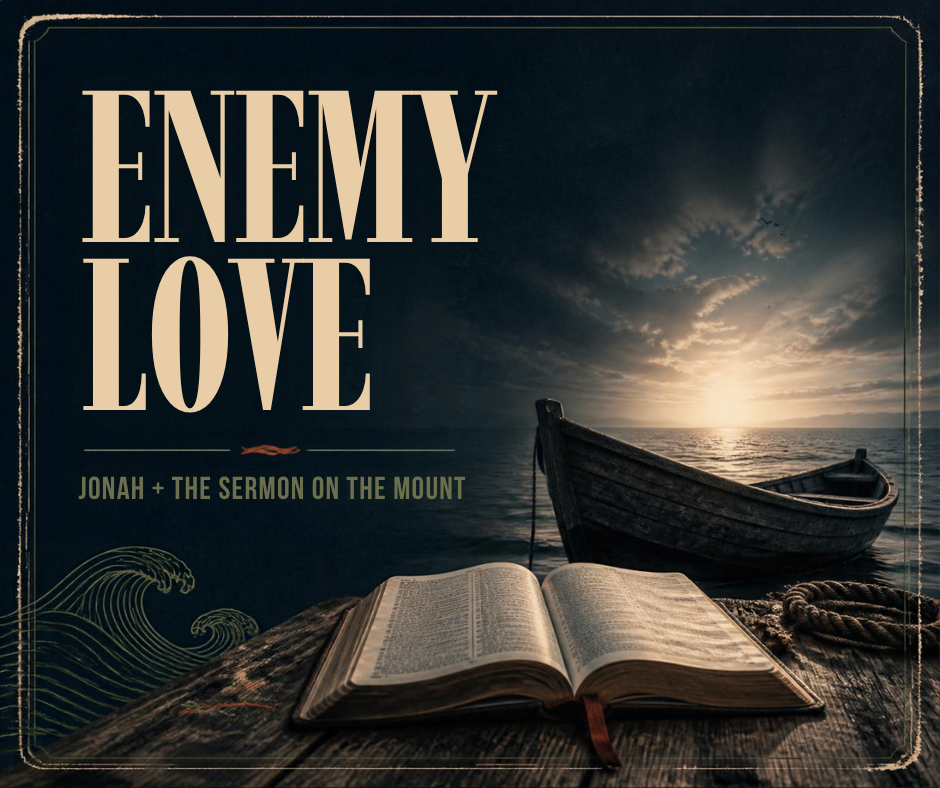
To listen to unabridged message click here: With or Without Us
God will bring peace whether we choose to join him or not
We are beginning a new series, and we’re going to spend the next four weeks looking at the little book of the prophet Jonah.
Now, you’ve probably heard sermons on Jonah before. In our family, the story of Jonah was the foundation of my son Ethan’s VeggieTales trauma.
When we were on staff with Campus Crusade for Christ, every other year we’d drive out to Fort Collins, Colorado, to Colorado State for staff conference. And it was the summer of Jonah and the Big Whale, the VeggieTales full-length feature film. Ethan loved that movie. So I did what you did in the early 2000s — I set the VCR to super long play, SLP, and recorded that movie over and over and over again for about twenty-four hours. And on the entire drive from Illinois to Colorado State, he watched Jonah and the Big Whale on loop. He did that again on the way home.
A couple of years later we were living in Michigan, sitting in worship, and the way they did the nursery was you got a little number for each kid when you checked them in, kind of like a library book in reverse. All of a sudden we see Ethan’s number flashing up on the screen. We run down there, and the nursery worker says, “I don’t know what happened — we put in a VeggieTales movie and Ethan lost it. He just started crying.”
Oh yes. He was traumatized by Jonah and the Big Whale from watching it way too many times. He now hates all things VeggieTales.
That movie is a wonderful, fun little story about fish slappers — a prophet who goes to tell people they should not slap one another with fishes. Oddly enough, we don’t know about any fish slapping happening in Nineveh. But Jonah is the story we’re going to sit with for the next four weeks, and we’re going to do something a little different with it.
Jonah as the mirror image of the Sermon on the Mount
I’ve been spending a lot of time reading the Sermon on the Mount devotionally — Matthew chapters 5, 6, and 7, over and over — because it feels to me like a section of Scripture we need to take more seriously. And by “we,” I mean I. I need to take it more seriously.
We have just five weeks from this Sunday until the beginning of Advent. Can you believe that? Five weeks. As I was praying about where we go for a few weeks, Jonah came to mind. It’s only about three pages. Won’t take that long.
I read through the story of Jonah, and it struck me: Jonah is kind of the mirror image of the Sermon on the Mount. It’s almost like an illustration — the anti-story. If you were preaching through the Sermon on the Mount, you might say, “If you want to see this not done well, go read the story of Jonah.”
Now, I started researching. Nobody talks about the Sermon on the Mount in connection to Jonah. And I have told you many times: the Bible is the most studied book in the history of mankind, and if somebody is coming up with something new, it’s probably wrong. So take this whole thing with a grain of salt. I don’t want to overstate the case. I don’t think that when Jesus was teaching the Sermon on the Mount he was thinking, “Jonah would be a great illustration against this.” Jonah was written hundreds of years before Jesus was on the scene.
But as you read the Scriptures and study them, you begin to see threads all over the place — echoes throughout the story of God’s people. I think that’s what we see here. Because one of the key statements of the Sermon on the Mount is this: “You have heard that it was said, ‘Love your neighbor’… But I tell you, love your enemies.”
Jesus calls us to love our enemies. He says, “What good is it if you just love the people who love you? Everybody does that. That’s not a big deal. You want to be countercultural? You want to love the way God loves? Love your enemies.”
And here we have the story of a guy who God calls to go preach to a group of people he really did not like.
“The word of the LORD came to Jonah son of Amittai: ‘Go to the great city of Nineveh and preach against it, because its wickedness has come up before me.’
“But Jonah ran away from the LORD and headed for Tarshish. He went down to Joppa, where he found a ship bound for that port. After paying the fare, he went aboard and sailed for Tarshish to flee from the LORD.
“Then the LORD sent a great wind on the sea, and such a violent storm arose that the ship threatened to break up. All the sailors were afraid and each cried out to his own god. And they threw the cargo into the sea to lighten the ship.
“But Jonah had gone below deck, where he lay down and fell into a deep sleep. The captain went to him and said, ‘How can you sleep? Get up and call on your God! Maybe he will take notice of us so that we will not perish.’
“Then the sailors said to each other, ‘Come, let us cast lots to find out who is responsible for this calamity.’ They cast lots and the lot fell on Jonah.
“So they asked him, ‘Tell us, who is responsible for making all this trouble for us? What kind of work do you do? Where do you come from? What is your country? From what people are you?’
“He answered, ‘I am a Hebrew and I worship the LORD, the God of heaven, who made the sea and the dry land.’
“This terrified them and they asked, ‘What have you done?’ (They knew he was running away from the LORD, because he had already told them so.)
“The sea was getting rougher and rougher, so they asked him, ‘What should we do to you to make the sea calm down for us?’
“‘Pick me up and throw me into the sea,’ he replied, ‘and it will become calm. I know that it is my fault that this great storm has come upon you.’
“Instead, the men did their best to row back to land, but they could not, for the sea grew even wilder than before. Then they cried out to the LORD, ‘Please, LORD, do not let us die for taking this man’s life. Do not hold us accountable for killing an innocent man. For you, LORD, have done as you pleased.’
“Then they took Jonah and threw him overboard, and the raging sea grew calm. At this the men greatly feared the LORD, and they offered a sacrifice to the LORD and made vows to him.” (Jonah 1:1–16)
God wakes us from our sleep
What strikes me about the opening of this story is the Beatitudes. “Blessed are the peacemakers, for they will be called children of God.” And “Blessed are those who hunger and thirst for righteousness, for they will be filled.”
Jonah was called to go to Nineveh to preach righteousness — to make peace. That is what a peacemaker does: stands between two parties at odds and brings them together. But Jonah gets on the boat and runs the other way. He is not obeying the Lord. He is not going to help bring righteousness. And so, from the moment that ship gets underway, there is no peace on it. The winds rage. The storm builds. Peace is gone.
And at the end — when Jonah gets thrown overboard — all of a sudden, now there’s peace.
I think the big idea here is that God will bring peace whether we choose to join him or not. Because Jonah, at the end of the story, has no desire to join God in any kind of peacemaking.
So why was he running? At the end of Jonah we find out that part of the reason was that he knew God was slow to anger and abounding in love — and that God would relent. He knew that when he went and preached God’s message, the Ninevites would repent and God would relent, because he is slow to anger and abounding in love.
And Jonah did not want to go.
Now, you might be thinking: Jonah, that seems silly. Don’t we want people to repent and embrace the love of God? Well — yes and no. Jonah was not being sent to strangers. He knew the Ninevites. They were not just an enemy. In 2 Kings, the Ninevites are kind of the symbol of all the evil in the world — the rising power of the Assyrian Empire that put Israel and that whole part of the world under its thumb. Assyria hadn’t reached its full power yet, but it was happening, and Nineveh was the picture of what it would become.
Jonah really did not want them to be saved. He did not want them to hear the message of the righteousness of God. He did not want God to relent. So he thought: if I run the other way, maybe God’s wrath will be poured out on these people, and they can finally get what they deserve.
And Jonah knew firsthand about God’s abounding love and mercy, because in his ministry in Israel he was a prophet to a king who “did evil in the eyes of the LORD” — you never want to be called that. In 2 Kings 14:23–27, under that evil king, Israel came back to its prominence. Its land expanded back out to the time of David and Solomon, in accordance with the word preached through Jonah son of Amittai. They deserved to be blotted out, but God said he would not blot them out yet. Instead, he blessed them.
So Jonah saw God’s love and compassion poured out on his own people, and he’s probably like, “Geez — I’m preaching this message, they’re not repenting, and you’re still blessing them?”
And we’re kind of like that too, aren’t we? You’ve got somebody in your life you’ve been talking to, trying to lead them in the right way, and they keep going the wrong way — and yet good things keep happening to them. You’re just like, “What? They keep being blessed for doing the wrong things.”
Jonah knew in his heart of hearts: if God does this for his own people who are totally rejecting him, what is he going to do for these evildoers, these people I hate and despise, if they actually repent? He’s going to relent. And that’s not okay with me.
So he gets on the boat. And he falls asleep. Probably because, in some sense, he’s unloaded his conscience — he told the sailors, “I’m running away from the LORD.” It’s kind of funny: in criminal situations, oftentimes a guilty man, when he is arrested and put in jail, will fall asleep. All of a sudden he’s not running anymore. It’s the innocent man who’s pacing and awake. The guilty man goes right to sleep.
Then the storm comes. And the storm is God waking Jonah up. The captain comes to wake him up: “What are you doing? There’s a storm. We’re all going to die.” The sailors cast lots, and the lot falls on Jonah — God’s sovereign hand on the lots. “Who are you? What do you do? Where are you from?”
“I am a Hebrew. And I worship the LORD, the God of heaven, who made the sea and the dry land.”
Jonah is making it very clear: the God he worships is in control of all of this. And it’s not lost on the sailors. “What do we have to do to you to make this stop?” And Jonah says, “Throw me overboard.”
God uses us in spite of ourselves
The sailors are good dudes. They don’t want to throw him overboard. They know if they do, he is dead. So they do their best to row back to land. They can’t, because the sea grows even wilder. So they call out to the LORD — “Don’t hold us accountable. He told us to do it.” They toss him overboard. Immediately the sea calms. And what do they do? They offer a sacrifice and make vows to the LORD. Most of the commentators I read think this is a picture of real repentance — these people really changing direction. They are now worshipers of the LORD, the same as Jonah.
So God wakes Jonah up. And then God uses him in spite of himself. Because Jonah is like, “I don’t want to be a part of this. I would rather die.”
Think about it: what if Jonah had just said, “You know what, guys, I’m supposed to be going to Nineveh. Can you just turn the boat around and take me there instead? I promise we’ll have clear sailing all the way.” That probably would have worked. Instead: “Toss me overboard. I’ll just die.” He would rather die than go to Nineveh and tell them about God, because he knew that the LORD is slow to anger and abounding in love.
And in our lives, to be peacemakers, there are times when God has to wake us up — wake us up so we can see the storm that is all around us. And then, more times than not, what is going to happen is that he is going to use us in spite of ourselves.
That’s what’s happening here.
Who are our Ninevites?
We know we have Ninevites, don’t we? We can read Jonah’s story and kind of be like, “Yeah, Jonah, I’m with you.” We giggle at it — that uncomfortable giggle — because we kind of know, deep down, that we probably would do the same thing.
So here’s my question for this week. As we consider the Sermon on the Mount, as we consider the call to love our enemies, as we consider the Beatitudes — blessed are the peacemakers, blessed are those who hunger and thirst for righteousness — who would we turn and walk away from if God called us to go peacemake with them?
Who are our people? Who are our Ninevites? Or in the words of the great VeggieTales creator Phil Vischer: who are our fish slappers?
Who are the people we are so disgusted by, that we despise so very much, that what we want for them is God’s wrath? What we want for them is to pay the full due for the penalty of their actions. Who is it?
And for some of us, we might be sitting here in our self-righteousness thinking, “I don’t have any of those people. I love everybody.” I don’t believe you. Because we all have that somebody. We all have that them. It might not be a big group of people. It might be one very specific person in our lives where we’re like, “Yeah — smite them. Smite them good.”
We are no better than Jonah. And there is a reason Jesus had to specifically say that his followers are to love their enemies. Because this is a part of us. Humanity is a tribal people. Insiders, outsiders — those who are with us, those who are against us. We divide all the time. Just look at the church. How many denominations are there? New ones every day. We find all kinds of new and special ways to divide and separate those of us who are followers of Jesus — who are supposed to be known for our love for one another, whose unity is supposed to be the ultimate apologetic for humanity.
And we sit here this morning and say, “Well, I love everyone.” Friends, we are no different than Jonah. There is somebody that if we were called to go make peace with, we would find a boat to Tarshish. We would find a boat that goes the other way. We would tell everyone who listens, “I’m running away from God and I don’t care who knows it.” And we would go to the bottom of the boat and fall asleep like any guilty man.
So that is the challenge for you this week: who are those people — or who is that person? I would challenge you to repent. I would challenge you to confess that true, deep hatred you might have for them. Confess to God and say, “God, I want to love them. I do not want to be a Jonah.”
Jonah is not a hero. Yes, Jonah eventually makes his way to Nineveh, and yes, he eventually preaches the message God put before him — and then Jonah is sick and angry and frustrated that God extended grace. Jonah is no hero. We are no heroes if we are upset and angry that those people find compassion, love, mercy, and grace.
You know what we are then? We are the older brother from the prodigal story — standing on the outside in the darkness while there’s a party going on, and we are not a part of it by our own choosing.
Guys, I am here to tell you there is so much joy, so much beauty, so much grace out in this world. So many good things happening, if we would choose to see it. But we are so much like Jonah that we look at the world and all we see is ugliness. All we see is bad.
Jonah’s story is a call to us. It is a warning to us to embrace the God who is slow to anger and abounding in love. If we say we follow him, then our lives ought to reflect that.
Heavenly Father, we thank you for your goodness, your grace, your mercy. And oftentimes we say that and we think primarily of ourselves — because your goodness, grace, and mercy has been so deeply extended to each of us. But the story of Jonah reminds us that this invitation goes to even those people. Lord, would you break our hearts for the people whom we hate? Would you break our hearts for the people whom we despise? Would you break our hearts for the people whom we wish your wrath would be poured on? Would you break our hearts for our own personal Ninevites, that we might be able to truly follow in the way of a God who is slow to anger and abounding in love. In Jesus’ name we pray. Amen.